Showing posts with label Vilene S320. Show all posts

Thursday, September 12, 2013

More Interfacing Comparisons

You may or may not remember that I posted about Pellon brand substitutes for the Vilene products that I use.  Since talking to the nice folks at the Bosal stand at Quilt Market in May, I've had every intention of doing something similar with their products.  Today was the day.
 
 
I started with the woven interfacings, and I really like Fashion Fuse.  It's a lot like Pellon Shapeflex, and looks a lot like the Vilene medium-weight woven fusible interfacing that I use and supply. 
 
That's the Fashion Fuse on the left (below) with my medium-light, medium and medium-heavy interfacings on the right.

 
Fashion Fuse fuses easily, and although it looks as opaque as somewhere between the Vilene medium and medium-heavy weights, it gives a smooth but slightly softer structure (equivalent to somewhere between the medium-light and medium weight Vilene interfacings). 
 
Whatever, it would be a perfectly fine substitute for medium-light or medium-weight woven interfacing, and would be a good interfacing for hats and bags and purses.

 
There's also a product called Craf-tex, which is similar to Timtex or Peltex.  It would work as an internal textile bag base, fused with interfacing.   

 
If I was looking for something along these lines to use in the body of a bag, I'd probably still go for Fast2Fuse by C&T Publishing.  Above, you can see Fast2Fuse top right and Peltex bottom right, and see the how much finer and more compressed the Fast2Fuse is.  It's much smoother when it's on a curve, and it is fusible on both sides.
 
This stuff intrigues me.....
...but I haven't played with it yet.
 
I had a look at a few fusible battings as an alternative to the H640 fusible wadding that I love so much.  This is Bosal's fusible batting on the top, The Warm Company's "Warm Fleece" in the middle and Victorian Textiles' fusible fleece on the bottom layer.
 
 
The Warm Fleece is very similar to Pellon's fusible batting.  It's a bit like felt, in a thickness that falls between H630 and H640, but it's a bit weightier than H640 and gives fairly solid structure.
 
The Bosal fleece feels a bit smoother and denser than the Warm Fleece and creates a slightly (ever-so-very-slightly..) thicker effect. Any of these would work as an alternative to H640
 
I found the Victorian Textiles batting to be a little loose and light, and is probably best suited to projects where it's pressed only once or with less heat that you'd use on a bag made with cotton fabric.  I found it shrank more easily than the others.
 
There's also a light Fusible batting from Bosal, which doesn't appear to be the case with the other companies.  This lighter weight batting is a good substitute for Vilene H630  light fusible wadding, although it's a denser structure and you'd need to be more careful about removing it from seam allowances where bulk might build up.  I really like it.
 

At Quilt Market in May, I discovered Soft and Stable by Annie.  It isn't fusible, but it has the effect of interfacing and wadding/fleece - the smoothness and the loft - that is so useful in bag-making.  I had every intention of putting it to the test as soon as I got back, but the last 4 months have seen me doing everything but testing it.

 
Has anyone used this... or the Bosal equivalent (which also comes in fusible form)?

 
It has a foam centre and a sort of tricot fabric bonded to both sides. 
 
In the photo below, the Bosal product is to the top and Soft and Stable is below it.  The fusible version fuses nicely and holds a smooth shape.  Using it, you'd have to be sure to remove it from seam allowances and topstitching, edge-stitching and under-stitching would be essential to hold it in place and create sharp, smooth seams and edges. 

 
As a substitute for Vilene S320, the closest I can find is Bosal's Shirt Fuse.  Like S320, it's a non-woven that is embossed with a texture that gives it a flexibility to emulate woven fabric. 

 
It also fuses well and remains flat and stable.  The main difference is that it's much softer (creating less structure) than S320.   In the photo below, S320 is on the left and Bosal Shirt Fuse is on the right.

 
Shirt Fuse would be a good substitute for S320 as a support for a zipper facing, but where the stiffness of S320 is needed, you might have to bring in some bigger guns....like Pellon Craft Fuse or Bosal Dura-Fuse (below).  Neither of these have the embossed texture (and therefore drape like cardboard) but they both have the lightweight, stiff structure of Vilene S320.
 
 
As with all interfacings, the best thing to do is to TRY them.  Test them on scarps of fabric.  Test them in combination with different wadding, fleece and other interfacings to see what they do.  And keep an eye out for new interfacings and support products.  The possibilities are endless and changing.

Wednesday, February 20, 2013

Comparing Vilene and Pellon Interfacings / Interlinings

Anyone who knows my work will know that I'm an unashamed interfacings geek.
 
I can (and do) bang on at about interfacings at great length and in an excited manner, and have a particular squeal of delight, reserved for those "Eureka" moments when I discover something new that can be achieved with the right choice of interfacing.
 
(Ok, I may be exaggerating about the squeal being exclusive to interfacing... I start throwing around hyperbole when I get excited...)
 
The tricky thing is, that when I recommend an interfacing in a pattern or book project, it's because the properties of that particular interfacing determines the look of the finished project ... but not all of the interfacings that I use are available worldwide (particularly in the USA).  And to complicate matters further, the products that are available as substitutes in other parts of the world (read: USA) are not necessarily available to me here, in Australia.  It's hard to know what to recommend when I don't know what the equivalents are.
 
Of course, there are online resources with substitution charts, but the little that I know is enough to know that these charts are not always reliable, for my purposes (for example, I saw Peltex 71 as a substitute for Vilene S520.  Peltex is simply not going to work for many of the uses that I have for Vilene S520). 
 
In a desperate attempt to give myself an International Interfacings Education (so that I can write an international sewing book), I begged the lovely folks at Pellon to send me samples of what they thought would be substitutes for the Vilene products that I use.  Bless them, they sent this box full.... and I've been playing with it for a couple of weeks.
 
So.. what did I discover?
 
I use three different weights of woven, fusible interfacing, from a soft collaring weight (medium-heavy)  through to a voile weight (medium-light).  Of course, there are other weights of woven interfacing available here - heavier and lighter - but these are the three that suit my needs for most things.
 
Pellon SF 101 (Shapeflex) comes in somewhere in the middle - like our medium weight.  It's a lovely interfacing and is a good all-rounder for bag-making.  If I suggest using "medium-heavy interfacing", you could probably get away with using Shapeflex, but if you have access to anything a smidge denser, I'd give that a go.  If I suggest using "medium-light interfacing", I'm referring to something about half the weight of Shapeflex (more gauze-like).
 
I use Vilene H630 and Vilene H640 Fleece/Wadding all of the time, to create structure in bags and purses.  They're lightweight, fusible and create loft without too much density (which makes them easy on the sewing machine needles), and they can be used in conjunction with other interfacings (read more about that here).

Pellon 987F Fusible Fleece is the recommended substitute for H630, but I think that it's more suitable as a substitute for H640.  It's denser (more felt-like) than both of  the Vilene fleece/wadding products, and the effect on the fabric is much heavier.  It creates much more structure (and thickness) than the light "oomph" that H630 gives to fabric.

You can see the difference a bit more clearly in profile... That's the Pellon fleece between the H640 (back) and H630 (front).

 I'm not sure what to suggest to use as a substiute for  H630 (light fusible fleece).  I'd welcome any suggestions from those of you in the USA (or other non-Vilene H630 territories), if you've found something to do the trick.

Fast2Fuse, Peltex and TimTex are all stiff, compressed-fibre interfacings, of diffferent densities and fusible properties.  Below, we have Heavyweight Fast2Fuse at front, TimTex in the middle and Peltex 71 at the back.
 Fast2Fuse comes in a Regular weight and Heavy weight.  I tend to use the Regular weight on the outside of bags and purses that I want stiffened (often with a layer of H630 between the fabric and the Fast2Fuse), and it's also handy for zipper tabs and some of the fancy new (secret squirrel) things I'm currently working on.  I use the heavy-weight when I want real box-like structure, or stiff bag bases.

I've done a comparison of Fast2Fuse and Peltex before.  For bag bases, Peltex is perfectly interchangeable with Fast2Fuse.  For finer work, I'd seek out Fast2Fuse if I could, and opt for Peltex if that's all I could find (2nd choice).  Peltex has the advantage of being available in both double-sided and single-sided fusible, as well as non-fusible.  Fast2Fuse is double-sided, which isn't always convenient.  Swings and roundabouts...

TimTex is about as thick as Peltex, but slightly denser (crisper?) and not fusible.  You can use it with fusible webbing (Vliesofix/wonderUnder/Bondaweb/Heat'nBond/Steam-a-Seam) to fuse it to fabric, or wrap it in fusible interfacing to make bag bases.

You can see the different densities and thicknesses in the profile shot, below.


Vilene S520 is an easy one.  It's almose identical to Pellon Deco-Fuse. 


Vilene S320 is one of my most-used interfacings, and unfortunately, I can't find an exact substitute for it. 

I love that the embossed surface  of Vilene S320 breaks that 'cardboard' surface effect that most non-wovens have, but apart from that property, it can be substituted with Pellon Craft Fuse.  Like S320, Craft Fuse fuses at low temperature and stays stable, and it gives about the same amount of support to the fabric, and it can be used in conjunction with fusible fleece.

I've only listed Vilene and Pellon products.... but there are other brands out there, and I don't have access to all that are on the shelves in the USA or Europe.

I'd like to open up the floor to any of you who'd like to offer any other suggestions. If you have anything that you feel might be useful, please feel fre to share it in the comment box below...

Wednesday, May 16, 2012

Zipping along....

...on the sewing machine, at least.  In real life, it's all butter-menthols and early nights (and a few hot whiskeys).
 While I'm not quite running on all eight cylinders, I'm using my limited energy to sew up samples, using the zipper samples I've made for ZIPPERS FOR BAGS workshops.  Next task is to cut and make up a new batch of zipper samples for classes.
I'm adding zips to bags where zips were not originally in the pattern, just to show you what's possible when you know a few zippy tricks.  The pocket configuration in this Laptop Bag is nothing like the original design, but could serve a different range of pockety needs.  (Yes - I just made up another word.)
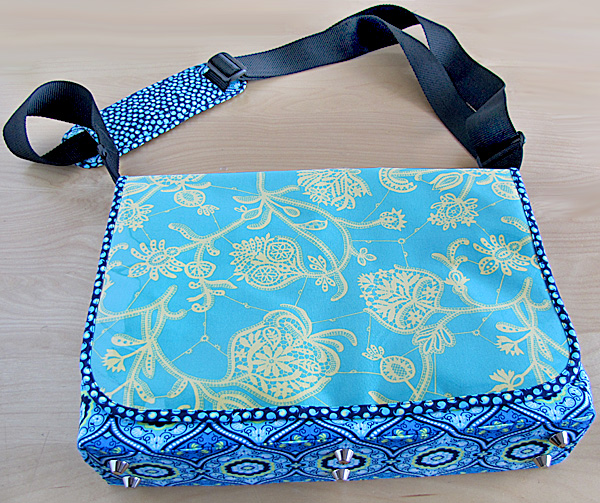
I used Amy Butler's "Lark" for this bag, interfaced with a combination of Vilene S320 and H640 fusible wadding.  I find that for large areas of fabric, the low melting-point adhesive on Vilene S320's makes it a breeze to apply.  The addition of H640 wadding gives the bag a springy, self-supporting structure that is easy to manipulate around the sewing machine.  You can see that I've waxed lyrical about this before..
I've used the same combination of interfacings on my project for Australian Homespun's project of the month, which should be out very soon ( I thought it was the May edition...?EDITED TO ADD - it's the JUNE edition).  Again, the fabric is Amy Butler's "Lark" range.

You can see how smooth the surface of the fabric is, and how self-supporting this bag is.  That'd be the interfacing combo....

Right now, I'm sipping hot lemon, honey and ginger at home, but I'm planning more zippered bag variations as we speak.

Oh, and since my August Zipper Workshop has booked out, I've schedued another date for a class in my studio - November 17th.  Needless to say, places book up quickly, so get in while you can!

LATE-BREAKING NEWS -
 Pattern Review have posted reviews and a giveaway of my book - HERE.  This might be a good opportunity for those of you in the USA to get your hands on it!

Wednesday, September 21, 2011

You learn something new every day.....

It's been a week of working through tedious technical stuff. Instructions. Ho hum.
With a materials list that included lots of Vilene S320 (and none of it's heavier cousin Vilene S520), I had to think outside the square (so to speak) when it came to protecting the fabric from the back of the magnetic catch. As I usually do these days, I used a 2.5cm (1") square of Peltex between the fabric and the back plate of the magnetic snap. But this time, I fused a few 5cm (2") squares of Vilene S320 over the back (instead of Vilene S520). It worked a treat!


Although not as cardboard-flat as S520, the layers can be fused on one-at-a-time with much lower heat and with less steam, and it sticks super-well to hold the snap and all the fabric surrounding it.

It doesn't actually need the reinforcement of the stitching around the Peltex square (because the Peltex and Vilene S320 are fused fast) but I still like the look if it. Ok - enough from me.... Back to the secret-squirrel cave....

Thursday, August 19, 2010

Combining Interfacings for bag-making

Interfacing is key to creating the right structure in handmade fabric bags. Often, we're using fabrics that were designed for drape or softness, and we need to make them have rigidity or at least a bit more body. For flexible (rather than rigid) structure, the combination of interfacing and wadding can be the answer.

Lighter fabrics need to be "flattened" with interfacing before a "plumping" layer of wadding is applied, otherwise the effect is merely puffy (the fabric is still floppy).

Sometimes this means that you'll be spending at least as much money on your interfacings as you have on your fabric. It really is worth the investment if you don't want to cheapen the look of your good fabric by using inferior support materials. (You can tart up cheap fabric with good interfacing and you can equally ruin good fabric with bad interfacing - the fabric takes on the properties of the support).

Through many trials and errors, I've learned a few interfacing combinations that work for me. I'd really recommend that you try a few as well - the more you test, the more you'll understand, and the better your ability to guess the likely outcome of any interfacing choice in the future.

When I want to add a bit of extra body to quilting weight cotton fabric, I use the combination of either medium-light or medium-heavy interfacing and light fusible wadding. The interfacing is fused in place first, followed by the wadding.


When in doubt, test both combinations on the same fabric....
You'll see and feel the difference and be able to choose which you prefer.

You may prefer the stand-up structure of the heavier (640) fusible wadding - combined with either of the above interfacings, and you may choose different interfacing combinations for different components of the same bag.

Another combination I truly, deeply love.... (I know, I'm gushing again...) is Vilene S320 and H640 (medium weight) fusible wadding.
The Vilene S320 fuses like a dream and gives a really flat finish but remains very flexible.

With a layer of 640 wadding, it holds its shape beautifully, yet is still light and flexible. I tried to show the flexibility in photos, but it didn't show it..... so I did a quick little amateur video (complete with a tripod-bumping incident) to demonstrate.


For the rest of the bag, I used different interfacings in different combinations....
Medium-light interfacing and light wadding on the strap, Vilene S320 (no wadding) on the facing and medium-light interfacing on the o-ring loops.

Of course, all this would be different on a different fabric and bag. It's really a matter of using the interfacing that will create the properties you want on each individual bag bit.


Wednesday, March 3, 2010

(Sewing) Class Roll

I've been looking for excuses to use Vilene S320, so I invented something. It's a sewing tool roll to hold the essentials for a craft class, "car craft" or indeed "lunch-meeting craft" (as I was seen to be doing on Tuesday.... talk about multi-tasking...!).


Here's a quick how-to...

1. These are the dimensions that I used - but you could vary them according to the size tools you're likely to carry. From the centre fold I measured out 11cm and drew a vertical line. Then I measured out another 15cm. From the bottom edge I measured up 8cm and I made the overall height 18cm.

2. Make your pattern and cut a curve between the 8cm mark and the top of the side section. (You can draw it freehand, trace around the side of a plate or make a straight line instead of a curve).


3. Block fuse some Vilene S320 to both the outer and lining fabrics and cut them out with the pattern. I find a small rotary cutter ("the sports blade") does the job beautifully.

(You might also notice that my preferred pattern weight is a piece of old railway line, but feel free to use the tools of your own choice!)

4. Cut a 20 x 16 cm piece of H640 wadding and fuse it to the back of the outside piece, centred horizintally and vertically. The seam allowances should be clear of wadding.


5. Cut a 6cm square of felt and a 21cm piece of 20mm wide elastic.


6. Stitch the felt to the lining piece with a single row of machine or hand stitches. Centre the elastic about 5-7 cm from the bottom edge.

7. Turn the ends of the elastic under and stitch it securely (reversing the full width of the elastic and back-tacking securely). Stitch 3 divisions - spaced 1.5cm apart - from each end of the elastic.

8. With right sides of fabric facing, stitch the two pieces together all around the outside edge using a 6-7mm (quarter inch) seam allowance - leaving a 10cm (4") gap in the bottom edge.

9. Clip the seam allowances away from each corner. Use pinking shears to trim around the curved edges. If you don't have pinking shears, you can either clip lots of tiny triangles out of the curves (or understitch/backstitch the lining side, if you know how to do do that... it's all explained in my patterns...).
10. Press the straight seam allowances open, including those at the gap in the bottom seam.

11. Turn the whole thing through to the right side out - taking particular care to turn the corners through sharply - and press it very flat.


12. At the opening in the base seam, take particular care to turn the seam allowances straight and flush with the rest of the seam. It's a good idea to slipstitch (ladder stitch) them together.

13. Topstitch a few millimetres from the top edge - from one curved edge, across the straight centre section and over the other curve.

14. Fold one edge over (creasing at the point where the curve ends) and press it flat.
15. Topstitch the edge in place through all layers of fabric.


16. Lay a piece of ribbon across the back of the wrap and fold the other edge over. Line up the ribbon so that it's level with the top of the folded-over area in the middle.


17. Stitch the folded edge down - through all layers of fabric and the ribbon. Stitch all the layers together along the bottom edge.


Fill it up with all the bits you're likely to need if you're crafting away from home and tri-fold it. Tie it up and off you go....

If you want to try this and need some Vilene S320, don't forget that it's on sale in the shop until this Friday (6th March 2010)... it's right here.